
Check-ins
Your Honeybadger account comes with check-ins, a way for the processes running on your servers to report that they are alive. Once configured, should a check-in go missing, Honeybadger will send you an alert to let you know that your process has stopped reporting. This is especially useful for monitoring cron jobs, so you can avoid having a cron job silently fail and go unnoticed.
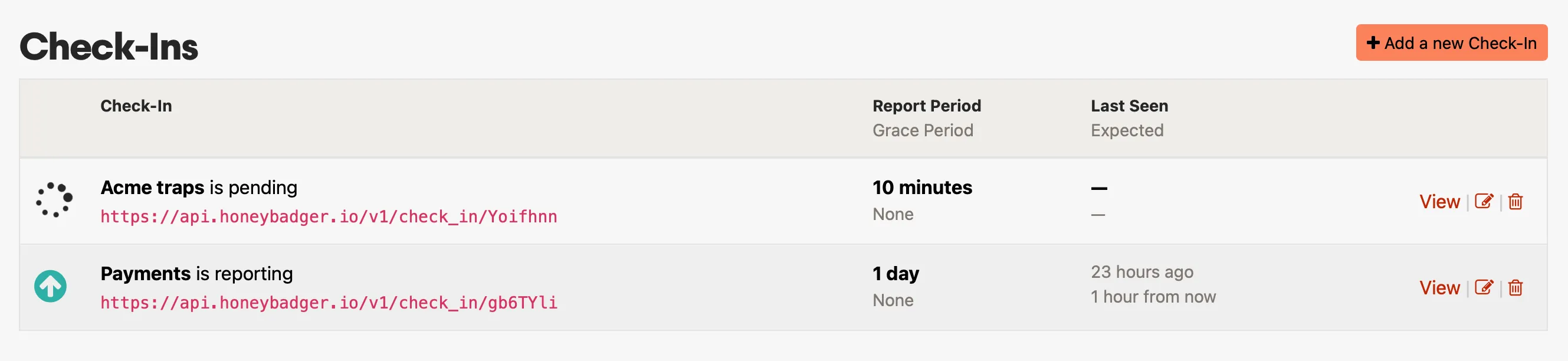
When you create a check-in, you’ll configure the following options:
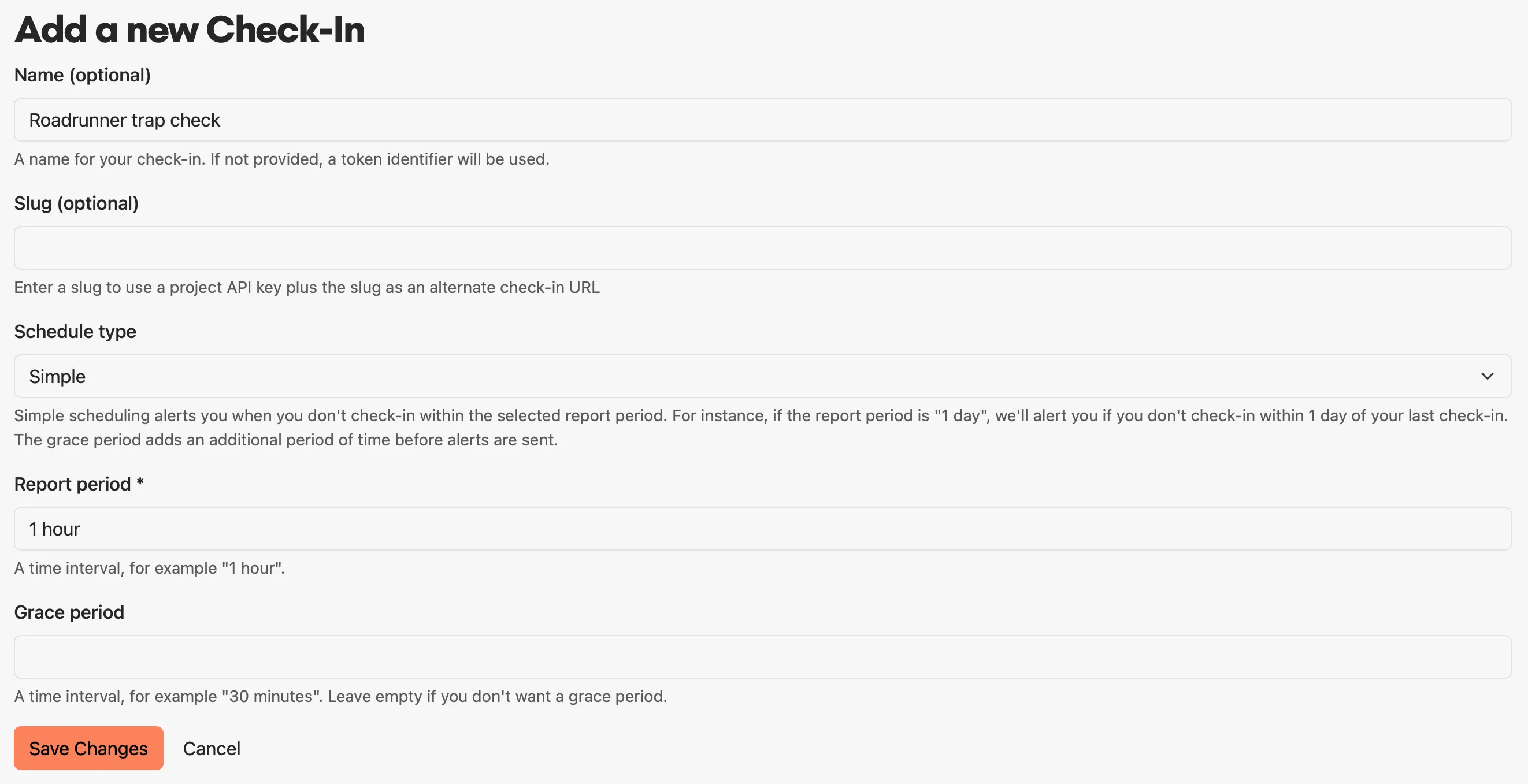
A label for your check-in. If not provided, a token identifier will be used.
An optional human-readable identifier that can be used as an alternate check-in URL. See Slugs below.
Schedule type
Section titled “Schedule type”Choose Simple to check in at a regular interval, or Cron to use a cron expression for advanced scheduling.
Simple
Section titled “Simple”Honeybadger will watch the process at an interval you define.
Report period
Section titled “Report period”How often you expect the check-in to report (e.g., “1 hour”).
Cron scheduling allows you to use a cron expression to create an advanced check-in schedule or mirror the cron schedule on your server.
Schedule
Section titled “Schedule”The cron expression (e.g., */5 * * * *).
Time zone
Section titled “Time zone”The time zone of the server where cron is running.
Grace period
Section titled “Grace period”An optional grace period allows some time for long-running tasks to be completed before Honeybadger sends a notification due to a lack of reporting. For example, if you have a job that reports every hour but can take up to twenty minutes to run, you can specify a grace period of twenty minutes, and Honeybadger will allow up to one hour and twenty minutes to elapse before a notification is sent.
Reporting
Section titled “Reporting”When you create a new check-in, you’ll get a URL that you can use to report that
your process is alive. The easiest way to report a check-in is with the
Honeybadger CLI’s hb check-in command:
@hourly /usr/bin/do_something && hb check-in --id XyZZyOr use curl to fetch the check-in URL directly:
@hourly /usr/bin/do_something && curl https://api.honeybadger.io/v1/check_in/XyZZy &> /dev/nullSee the API docs for more information about the data you can send when reporting a check-in.
You will also get an email address you can use for reporting the status of your process. No subject or body text is required, but the email address is case-sensitive:
@hourly /usr/bin/do_something && echo | mail XyZZy@report.hbchk.inPlease note that while these examples use cron, you can trigger check-in reporting from the shell, a scheduled background job, or any other process that can request a URL or send an email.
A slug is an optional, human-readable identifier for a check-in. When you add a
slug, you get an alternate check-in URL that uses the slug and a project API
key instead of the check-in ID. This is useful if
you don’t want to embed check-in IDs in your code or automated systems. For
example, if you specify a slug of hourly-check, your alternate check-in URL
will look like:
https://api.honeybadger.io/v1/check_in/hbp_ABC/hourly-checkYou can add a slug when creating a check-in in the UI, via the REST API, or in a config file using our PHP/Laravel and JavaScript client libraries.
Payloads
Section titled “Payloads”You can POST a small payload to the UI that includes the results of the command you ran, including the command’s output, exit code, and duration. Please see our API documentation for the format of that payload.


The easiest way to send check-in payloads is to use the Honeybadger CLI’s hb run command to wrap your scheduled command:
hb run --id XyZZy -- /usr/local/bin/backup.shOr POST directly to the check-in API with a JSON payload:
curl -X POST https://api.honeybadger.io/v1/check_in/XyZZy \ -H "Content-Type: application/json" \ -d '{"check_in": {"status": "success", "duration": 1234, "stdout": "backup completed"}}'You can view the payload data in your check-in history or query it in Insights.
Notifications
Section titled “Notifications”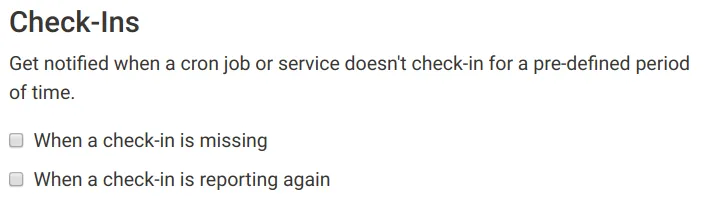
When your check-in goes missing, we’ll notify you with information about which job failed to report on time. You can enable or disable these notifications along with the rest of the notification events in your Personal Alerts or Project Integrations settings.
Status page integration
Section titled “Status page integration”Check out our Status Pages feature for information on how to present the status your check-ins to your users.